LXILC  Legacy Experience Initiative LC · Las Vegas, Nevada

Offline computation for the intelligence analyst

PARAIBELCOM reconstructs what is known about an adversary from the reports that actually arrived, says when a decision has to be taken and what single observation would change it, plays every friendly plan against every adversary plan before it ranks anything, and keeps testing the retained plan as each new report arrives. It runs on a laptop, and on a disconnected handset.

The computation makes the decision. The language model only explains it. Turn the language model off and the decision is identical. Nothing in the system invents a probability, and what it cannot compute it names — with the reason — instead of estimating it.

See it run

Six minutes, one laptop, no network. The reports arriving, the state rebuilt at a chosen instant, every friendly plan played against every adversary plan, the second opinion, the unit-level concepts, and the same engine answering on a disconnected handset. Nothing is sped up and nothing is cut.

PARAIBELCOM demonstration

The video loads from YouTube only when you press play — nothing is requested from a third party before that. Open it there instead.

One loop, not a tool

Every product is a view over the same reconstructed state. No stage is allowed to invent an input that the stage before it did not supply.

Interview & source→ Report→ Situation→ Event→ Collection→ Course of action→ Decision→ new report↻
Provenance is attached where the report is born, not reconstructed three stages later.
The loop closes: a decision produces an information requirement, which produces a collection task, which produces the next report.

Four decision products

Each answers one question a staff officer actually asks — and each states what it will not claim.

Courses of action

“Why this plan, and not the other one?”

Friendly plans are generated, adversary plans are generated against them, and every friendly plan is played against every adversary plan — a million engagements, without sampling or pruning. What comes out is a portfolio with weights, not a single recommendation. Ranking uses a value function the operator sets and can read, over five measured features.

RefusesNo word in a commander’s intent can promote a plan. Intent moves weights; weights order a board. A concept the engine cannot measure is named and given no weight.

Situation template

“Is this position even possible, given everything we have seen?”

The adversary formation state is reconstructed at any point in the reporting timeline. Observed, declared, assessed and unknown are separated. A stale position stays marked stale instead of being presented as current, and where a formation has not been seen recently the system shows where it could still be rather than inventing a position for it.

RefusesA report whose claimed movement is not achievable in the time available is flagged, not deleted. The analyst decides what it means.

Event template

“What would make me change this plan, and how long do I have?”

Sorted by decision deadline, not by score — an event template is read to find out what has to be settled first. Each row gives the event, the time of contact, what the observation would be worth if it were made, and where the indicator stops discriminating between competing explanations.

RefusesThe figure beside each row is an assessment score, never a percentage. An observation compatible with every hypothesis confirms none of them — and the product says so.

Collection plan

“What do I still not know, who can look, and by when?”

The written intelligence requirements are held as written, and what the system’s own state says is unresolved is computed separately — then the divergence between the two lists is published. Where they agree, the plan is confirmed. Where they differ, the difference is the product.

RefusesCollectors are not ranked when the available documents do not support a ranking, and the attributes that would be needed are listed by name. A candidate is not a tasking.

The plan does not end at the briefing

A course of action is retained by a named person. From then on, every batch of reports that arrives is an advance of the clock — and the question is no longer which plan is best, but whether the retained plan still holds, and on what evidence.

Plan retained by a named person→ Reports received→ Advance of the clock→ CONTINUEADJUSTREPLANUNDETERMINED→ Named decision↻
UNDETERMINED is a verdict, not a failure: when the evidence needed to judge the plan is missing or too old, the engine says so and names what is missing.
The reports can be stepped in slices of 15, 30, 45 or 60 minutes; one slice is one evaluation, every report in it keeping its own observed and received times.

Received is not observed

“What did we know, and when did we know it?”

Every report carries three clocks — observed, reported, received. A report is new when it was received since the last state, even if it describes an older moment; a late report is shown as late, because it may change what the previous evaluation should have said.

RefusesA report is never back-dated into a state that could not have known it. The picture at a given instant is only what was held as usable at that instant.

Age is a property of the evidence

“How old is what we believe about each adversary formation?”

For each formation the engine publishes the age of its last report against a declared staleness horizon, the source of that horizon, and the next moment at which the picture will change by itself because evidence ages out — before anyone asks.

RefusesA stale formation is not presented as immobile, and the horizon is shown as a declared assumption, not as a fact about the adversary.

Own forces as planned, not as observed

“Where should our units be by now?”

At each advance the retained plan places every friendly unit — route completed, route remaining, position at that clock — from the same derivation the verdict rests on, so the map and the decision cannot tell two different stories. An operator’s declaration replaces the planned position the moment it is made.

RefusesA planned position is never displayed as a report. Where the state holds no position, nothing is drawn.

A proposal is not an order

“What would the system change — and who decides?”

The engine may propose to continue, to integrate a unit into the frozen plan or to switch concept, with its rule and its ties stated. When there is nothing to decide — no friendly force declared at that time — it says exactly that, instead of presenting an empty plan as an answer.

RefusesNo proposal is ever applied by the system. The retained plan changes only when a named person retains another.
Every state is a fold over a journal of declarations, not an object that is modified in place. Any advance can be replayed from the record and compared byte for byte; going back in time re-displays a state, it never recomputes or erases one. Declarations accumulate with their time — what was declared at the first advance is still there at the third.

Why it is built this way

Four commitments explain most of the design. Each one costs something, and the cost is stated — a principle whose price is not named is a slogan.

Measured and assumed are separated, always

Every line is marked observed, declared, assessed or unknown, and the marking travels inside the data rather than living in the interface — so a change of screen cannot strip it.

Cost — products look emptier than a competitor’s. Fields that could be filled plausibly are left visibly empty.

What cannot be computed is named, never estimated

A gap reads as a gap, and the missing input is identifiable by name. A measurement that arrives blank is refused rather than coerced to zero.

Cost — the system regularly declines to answer questions it is asked, including during demonstrations.

No invented probabilities

Write “62 %” in a doctrinal product and it will be read as a frequency — and nobody downstream will ask again. The system prints an assessment score with its nature attached and takes the explanatory burden instead.

Cost — scores are harder to explain than percentages, and the explanation has to be repeated.

The adversary is not predicted; the discriminating observation is found

Predicting what an adversary commander will do is not a solved problem and we do not claim it. Identifying the place and the time at which one observation would separate two hypotheses is computable — and it is what a collection manager can act on this afternoon.

Cost — it never produces the confident single forecast that briefs well.

Five questions, not five algorithms

A plan can be optimal against one opponent and dangerously fragile against another. The design problem is not to combine methods; it is to connect different mathematical questions without confusing their answers.

MethodQuestion it answersFailure mode it addressesWhat it does not settle
MAP-ElitesWhich strategically distinct courses of action exist — not only the highest-scoring one?Premature convergence on a single family of plansWhether any of them holds against a responding adversary
LanchesterWhat happens when this friendly plan meets that adversary plan, under declared assumptions?Interactions left implicitThe truth of the assumptions: the payoff matrix is a model, not ground truth
NashWhat if the opponent responds strategically rather than as a fixed sample?Ranking plans as if the adversary did not chooseOperational robustness: an equilibrium is conditional on the matrix
Monte CarloWhich conclusions survive when the modelled conditions are perturbed?Confusing expected performance with ranking stabilityWhich perturbations matter in the real world
NEMESISWhich adversary plan hurts this plan most — and can the plan be repaired?Resilience that only holds against sampled opponentsAdversaries the model cannot represent
Aij = U(BLUEi, REDj | θ)θ = the declared assumptions governing the simulated engagement — published with every result
None of these methods eliminates the limitations of the others, and none turns a model into certainty. The question the system is built to answer is not “which plan scores highest?” but “which conclusions remain defensible when the opponent responds and the assumptions change?”
Inside PARAIBELCOM — the six-part engineering seriesone component, one engineering story: MAP-Elites, Lanchester, Nash, Monte Carlo, NEMESIS, and the system.

On the phones a team already carries: ATAK, plus a network of its own

PARAIBELCOM for ATAK is a set of independent ATAK plugins and a private team network. It works with no cellular service, no server, no account and no cloud.

PARAIBELCOM Mobile running offline on a handset
The toolbox · 2 min 53

No signal. No cloud. No internet. Still operational.

Running fully offline on a Samsung Galaxy S26 Ultra with 16 GB of RAM, local AI models and the device’s own sensors. In this demonstration:

  • Offline AI assistance and military medical support
  • Field reporting and multilingual translation
  • Military doctrine and reference libraries
  • Emergency signalling and coordinate conversion
  • Acoustic monitoring and experimental electronic-device sensing
  • Intelligence interviews, source comparison and human-controlled validation

Each module is a separate ATAK plugin: installed on its own, adapted, replaced or expanded according to the mission, the sensors on hand and the computing power available. The decision engine runs on the workstation.

The network should be an advantage. Not a requirement.

The video loads from YouTube only when you press play. Open it there instead.

A team network that needs no server

Phones and tablets running ATAK find each other and form their own private network over Bluetooth and Wi-Fi. For each neighbour the service picks the carrier that works: Wi-Fi when both ends have it, otherwise Bluetooth, and ultrasound for short codes when no radio can be used. Positions, chat and alerts keep flowing between devices that have lost their server and their cellular link. Frames are encrypted and authenticated; unacknowledged messages are re-sent; a LINKS screen shows every neighbour, its carrier and its signal. It complements radio meshes; it does not replace them.

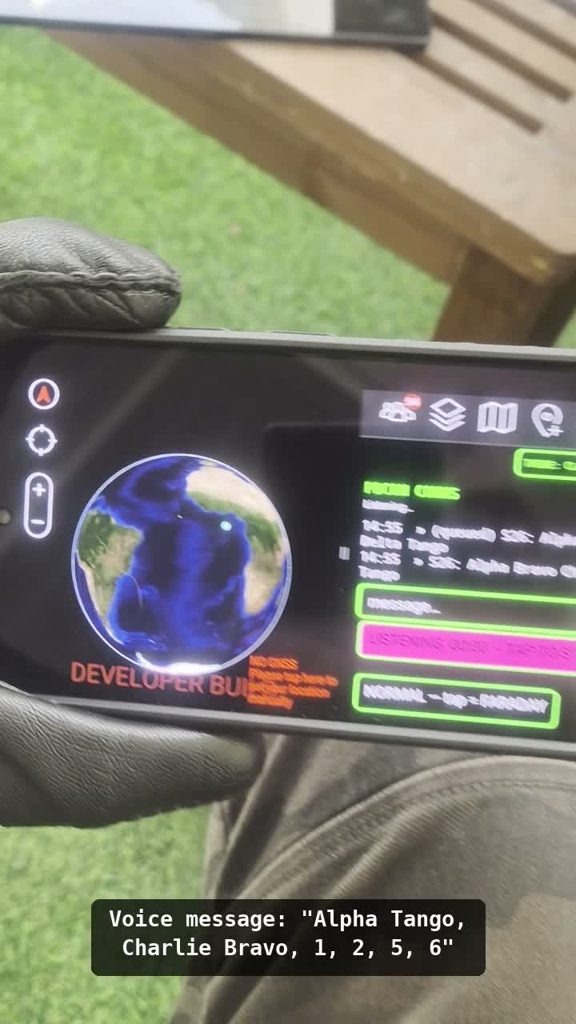
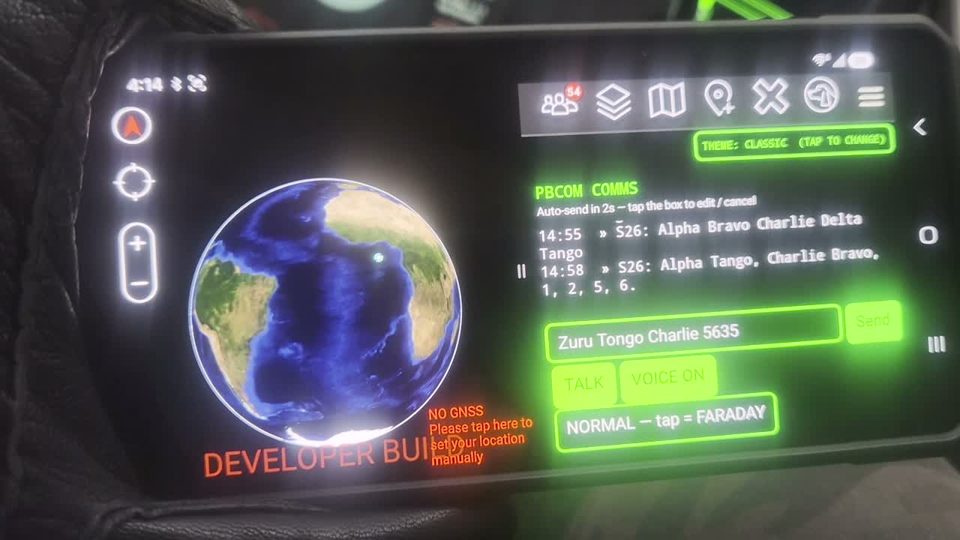
Play: one spoken message sent to the whole fleet
COMMS · fleet · 29 s

One spoken message, the whole fleet

A voice message goes out from one handset and is read aloud on the others, through the private network.

Play: spoken messages between tablets and a phone
COMMS · tablets · 27 s

Voice messages between tablets and phones

The same network carries spoken messages between tablets and phones, with no server in the loop.

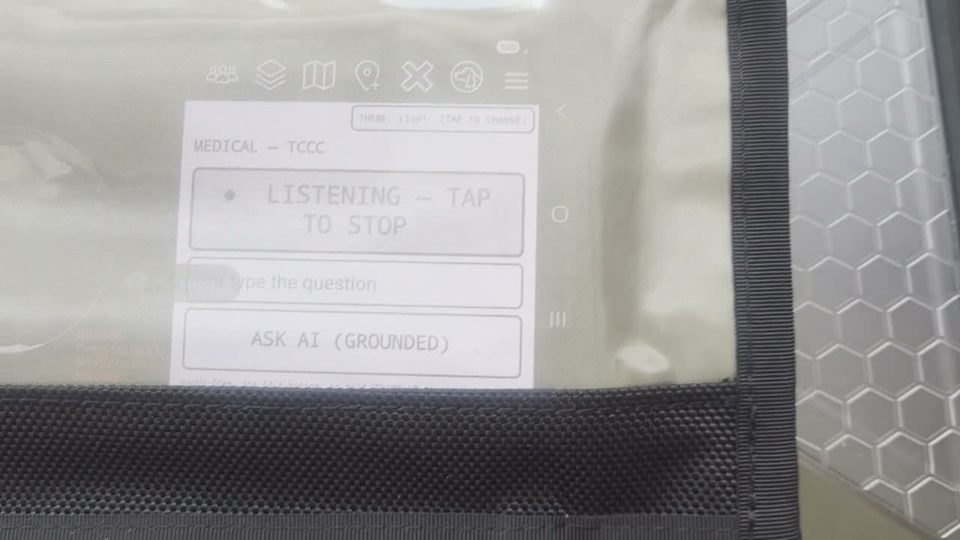
Play: ATAK sealed in a Faraday pouch, answering from a local AI
ATAK in a pouch · 1 min 8

Sealed in a Faraday pouch, still working

ATAK runs with the PARAIBELCOM plugins inside a shielding pouch, worked by stylus and by voice. A medical question goes to the AI on the phone, which answers from the TCCC cards, offline.

Play: the translator working inside a Faraday pouch
Translator · no network · 20 s

Translation with no network

The phone is sealed in a Faraday pouch. A French sentence is heard, the language is detected by itself, and the English translation appears on the phone: speech recognition and translation both run on the device. Language detection has been tested on 14 languages.

ATAK plugins: reporting, language and record

VOICEdictate a SALUTE report, review it, export CoT, ATAK data packages and KML
TRANSLATORoffline voice translation, with a full-screen view to hand to the other person
SOURCEinterview a source offline: transcribe, translate, and mark every claim against the file carried on the device
JOURNALdated, position-stamped entries; drafts a report
TCCC MEDICALcasualty care cards: triage and the MARCH sequence at the point of injury
DOCTRINEoffline retrieval over doctrinal publications: the passage, not a paraphrase
AIa local assistant on the phone, serving a chat endpoint to the other modules and to third-party tools

ATAK plugins: sensing and signalling

SENTINELa phone set down watches with motion, sound and sonar; a leader’s wall shows every device
SENSORSthe phone’s own sensors as map contacts and readings
SWEEPfinds metal and electronics near the device and drops a contact on the ATAK map
SIGNALsignalling with no radio: morse by screen light and by vibration
COMMSspoken and typed messages over the team network, with an optional silent mode
COREone launcher button; one tile per installed module; three display themes
Open interfaces: the team network exposes a read-only link-state feed on the device and a CoT endpoint for ATAK, documented field by field, and the local AI speaks a common chat format. Maturity varies, and each module says so on its own screen; several state plainly that no detection rate has been measured. PARAIBELCOM is independent software and is not affiliated with or endorsed by the TAK Product Center or the U.S. Department of Defense.

The standalone handset app of earlier versions (decision engine, reconnaissance capture, dead reckoning, echo ranging) is still available separately; the decision engine otherwise runs on the workstation.

How you would know it works

None of this is a claim about military effectiveness. They are claims about the engineering — the kind that can be checked by somebody who does not trust us.

106
engagements per turn — every friendly plan against every adversary plan, without sampling or pruning
~6 s
a full generate-and-solve turn on a laptop; about 20 s on a handset in airplane mode, reaching the same verdict on the same state and seed
identical
same inputs, same outputs — tested, not asserted. Two identical requests differ in elapsed time and nothing else
17 days
three new analyst capabilities, one of them in two days, from a need an analyst stated out loud
418 automated test suites, 61,200 lines, run against the behaviour, including suites whose only purpose is to assert refusals: that a blank measurement is declined, that an unavailable input produces a named gap, that a catalogue with no modelled effect changes no decision.
The part that matters more than the pass counts. A number of real defects in this system were found by us, on our own instruments, and the measured consequence of each was written into the source beside the fix. One example, because it is the kind of failure that does not announce itself: an internal computation collapsed as evidence accumulated — with ten reports it produced tens of thousands of hypotheses and beliefs that moved when new evidence arrived; with twenty reports it produced none at all, and the board read “no threat anywhere” at full confidence. It went blind precisely as intelligence accumulated, silently. It was found by measurement, not by a crash.
And the instrument that catches us. Under a pre-registered self-blind protocol, our own pipeline detected fewer seeded flaws than the baseline it was meant to beat — 14 of 120 against 56 of 120, paired McNemar p = 1.3 × 10⁻¹⁰, false positives included. We published that result. An instrument that only flatters its author is not an instrument.
The ceiling, stated first. The attrition relationships are declared planning figures, not fitted to a dataset. There is no analyst trial, no human baseline and no calibration claim. The system’s numbers are reproducible, and they are not externally validated. What would change that is authoritative data and analysts to validate against.
Alexandre Mogilamy
Principal Investigator — Legacy Experience Initiative LC (LXILC)
info@lxilc.com  ·  +1 786-444-5639  ·  Las Vegas, Nevada
CAGE 17WT5SAM registeredCMMC Level 1 · self-assessedUS person

Detailed technical papers — the mathematics, the input formats, the measured cost of each product and what each one refuses to do — exist for four analyst tasks and are available on request.
© 2026 Legacy Experience Initiative LC. PARAIBELCOM is a product of LXILC.